Our new paper on nuclear architecture and stem cell differentiation is now available on bioRxiv:
DOI: 10.64898/2026.09.16.752023
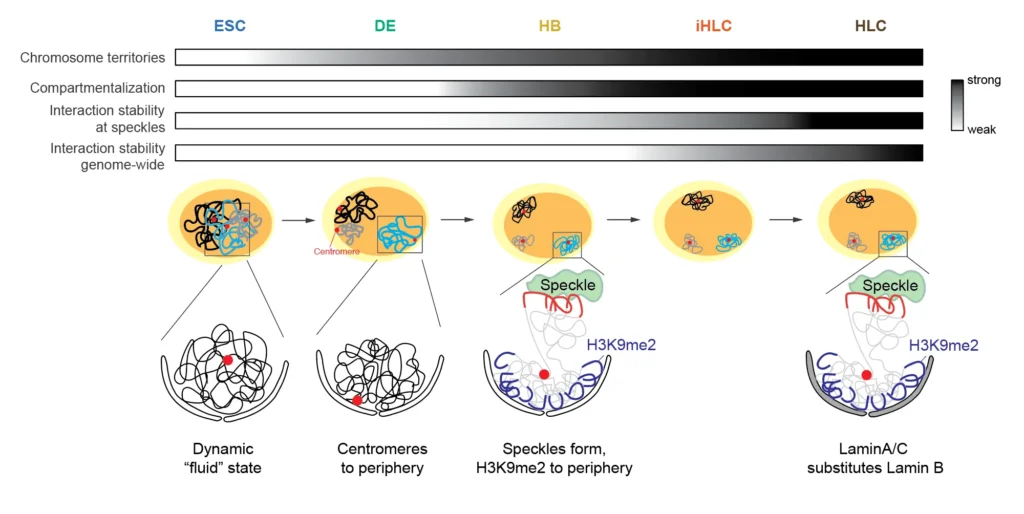
Cellular differentiation is an extraordinarily complex process, often lacking single, universal rules. However, by tracking nuclear dynamics on a unified timeline, our collaborative team demonstrated that nuclear reorganization does not occur via a single coordinated switch. Instead, it unfolds across three major transitions:
(1) pluripotency exit: formation of individualized chromosome territories and a transient excursion of centromeres towards the nuclear periphery.
(2) hepatic commitment: marked increases in compartmentalization and consolidation of nuclear speckles.
(3) chromatin maturation: structural interaction stabilization (“hardening”) and broad spreading of H3K27me3 domains.
To achieve these conclusions, the team established fascinating five-stage differentiation system mapping H1 human embryonic stem cells (hESCs) to hepatocyte-like cells (HLCs), profiling it with an armory of experimental techniques including Hi-C, Liquid Chromatin Hi-C (LC-Hi-C), and various omics assays.
For me personally, this project has been a long and rewarding journey. My own analytical contributions to this work began back in 2022, and I am deeply grateful to the team for keeping me involved as the project evolved over the years — expanding the analyses, exchanging feedback, and integrating edits seamlessly.
This effort spans several laboratories across Phase II of the 4DN Consortium (the Mirny, Maehr, Dekker, and Abdennur labs). A huge congratulations to my co-authors, with special recognition to first author Xiangru for her extraordinary dedication and brilliant work bringing this massive study to fruition.