Our study on early genome folding and the discovery of chromatin “fountains” is published in Nature Communications:
Title: Extrusion fountains are hallmarks of chromosome organization emerging upon zygotic genome activation
DOI / Paper: https://doi.org/10.1038/s41467-026-69105-9
Key findings
The initiation of gene expression during early embryonic development—known as zygotic genome activation (ZGA)—is accompanied by dramatic spatial reorganization of the genome. However, the earliest structural triggers that initiate chromosome folding have long remained elusive.
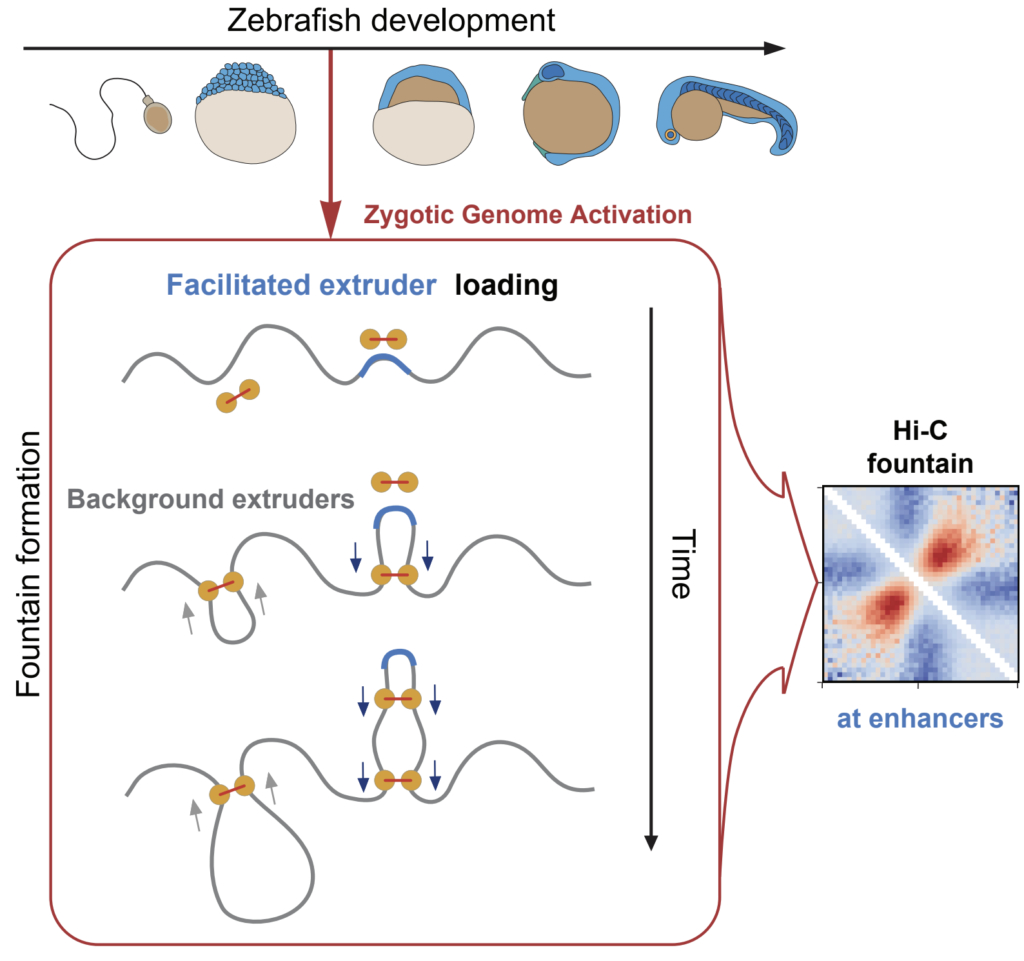
By tracking genome architecture during early zebrafish embryogenesis, our team discovered “fountains” — a novel class of Hi-C structural features that mark the initial starting points of 3D chromosome organization:
- Enhancer-driven emergence: Fountains form preferentially at active developmental enhancers driven by pioneer transcription factors. Knockouts of these key pioneer TFs lead to a specific loss of fountains, establishing a direct causal link between enhancer activation and 3D nuclear architecture.
- Facilitated cohesin loading: Polymer simulations and molecular profiling show that fountains represent primary sites of targeted, facilitated cohesin loading. Cohesin initially accumulates at enhancers before redistributing along chromatin to CTCF-bound TAD borders via two-sided, desynchronized loop extrusion.
- Cohesin dependency & generality: Fountains disappear upon acute cohesin degradation or during mitosis, and rapidly reemerge as cohesin reloads in early G1.Beyond zebrafish embryos, similar fountain patterns appear across mammalian systems (such as mouse stem cells), pointing to a universal mechanism of enhancer-mediated genome folding.
To uncover these principles, the project integrated high-resolution embryonic Hi-C, genetic knockouts, omics assays, and biophysical polymer modeling.
Personal note & acknowledgments
Uncovering fountains and decoding the biophysical rules behind them has been an incredible intellectual journey. Combining polymer physics with developmental genomics allowed us to turn unexpected genomic patterns into a clear mechanistic model of how enhancers instruct chromosome architecture.
This work was a close collaboration across multiple institutions and disciplines, uniting teams from MIT, the University of Freiburg, and partner research institutes. A huge thank you to co-lead author Sergey Ulianov, senior authors Leonid Mirny, Daria Onichtchouk, and Sergey Razin, and all our wonderful co-authors whose dedication made this breakthrough possible!